Pittsburgh Jazz Collective: Designing the Sound
A two-disc jazz album gives you a lot more to work with than a square thumbnail on a streaming service. It also gives you nineteen tracks, seven musicians, liner notes, credits, photographs, and two actual discs, all of which have to fit inside something roughly the size of a very unsatisfyingly small sandwich. Album design is very often an exercise in convincing a book the size of Atlas Shrugged to fit into something even smaller than a Little Golden Book.
This one also came with a lot of history.
Mike Tomaro brought me in to design the physical CD package for the Pittsburgh Jazz Collective and to photograph the seven members of the group. Working with Mike made the project especially meaningful for me. He was one of my mentors when I was a student at Duquesne University, and over the years I’ve been extraordinarily fortunate to also call him a colleague and dear friend. Before his retirement, we worked together for more than a decade at our mutual alma mater, so contributing to a project built from music he has spent so much of his career arranging, performing, and teaching felt especially meaningful. It’s the kind of full-circle opportunity I never could have imagined when I was his student.
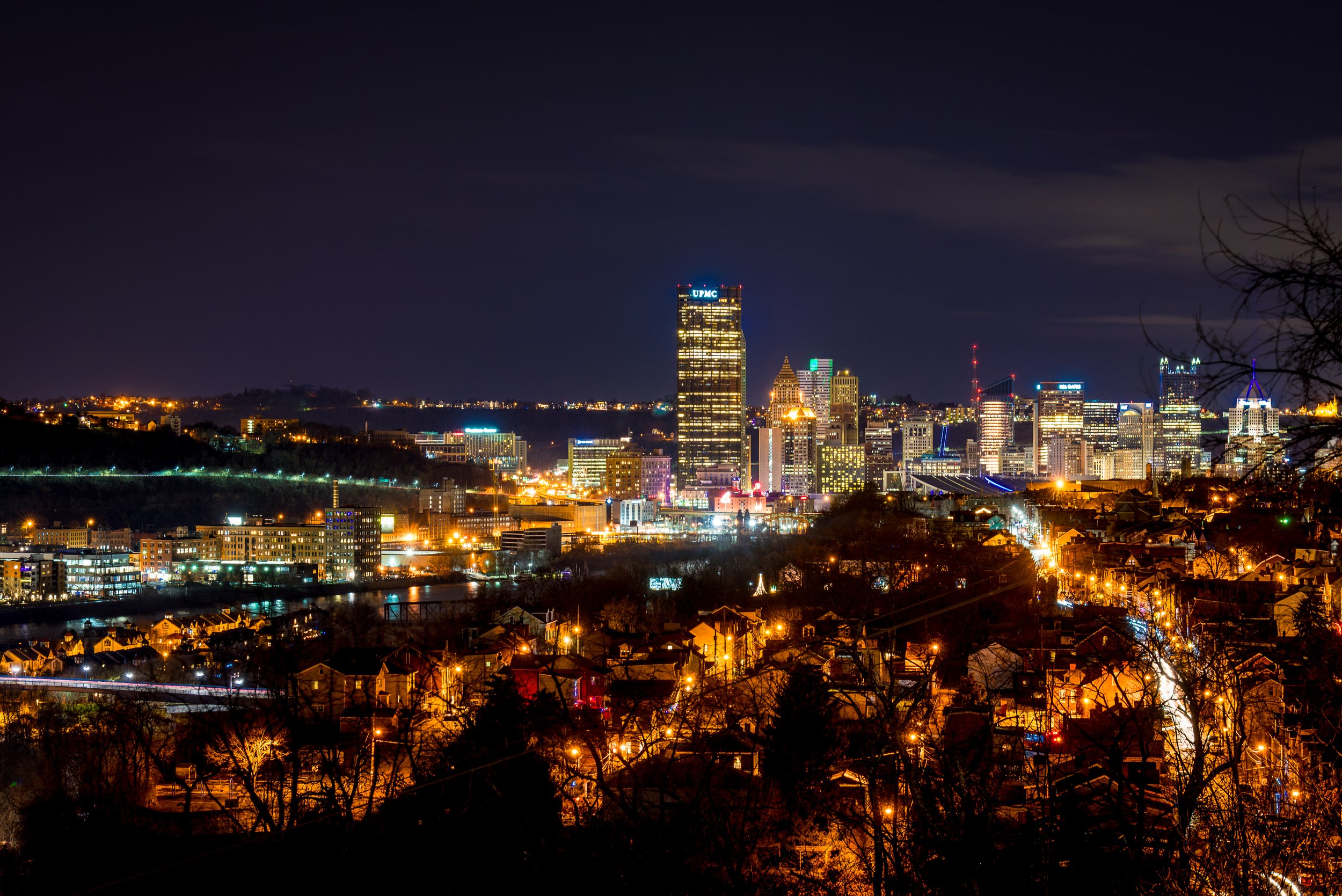
The album design began very simply. I put together a gallery of my Pittsburgh photographs for Mike and the project’s executive producer, Dr. David Beaudreau, to consider. They selected a nighttime view across the city, with a neighborhood in the foreground and the skyline stretching across the distance.
Once they chose it, the rest of the package had somewhere to begin.
Pittsburgh as the starting point
The album itself is divided into two ideas.
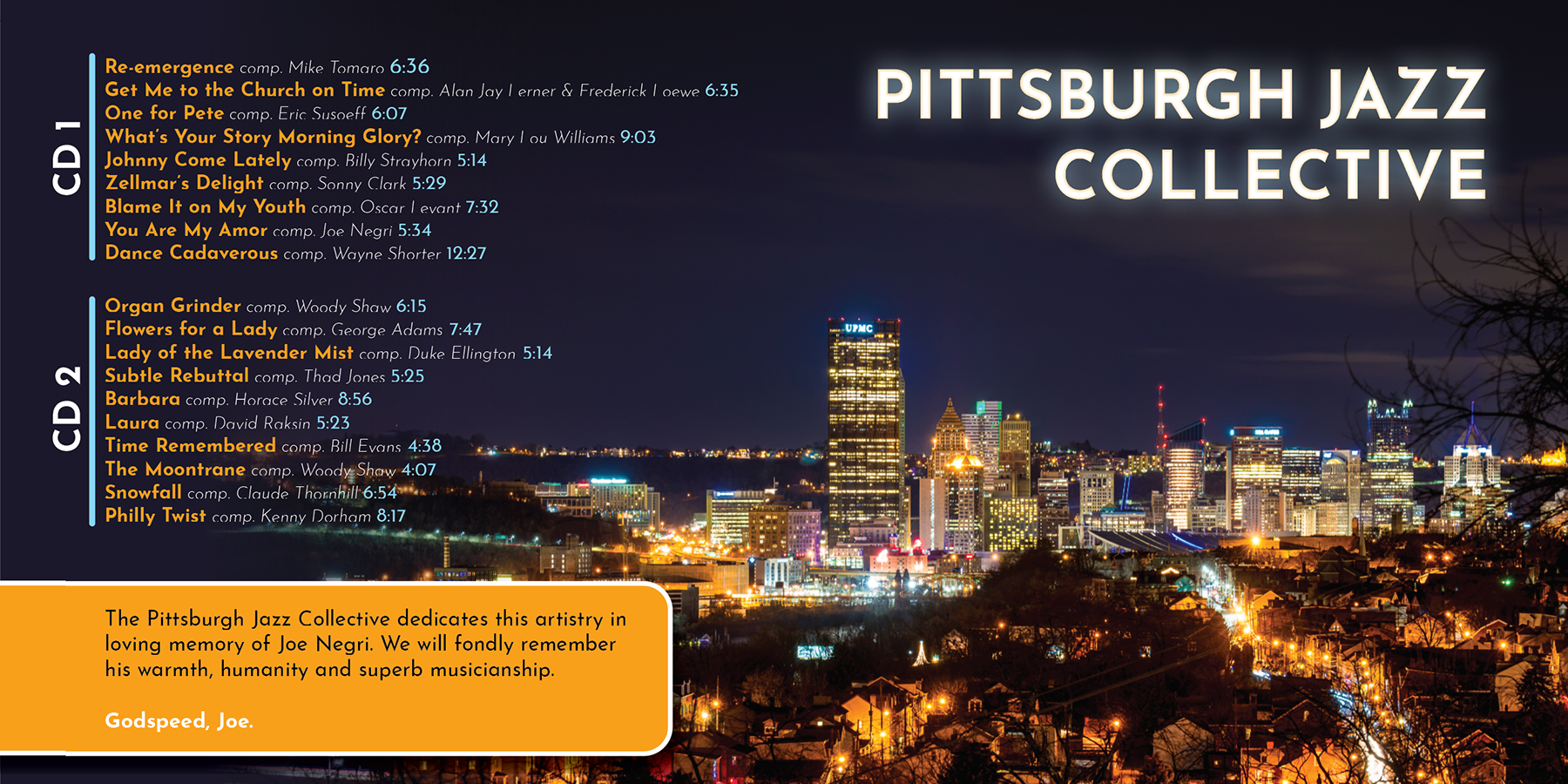
The first disc, An Homage to Our Pittsburgh Roots, contains nine pieces connected in different ways to Pittsburgh and its musical history. Mary Lou Williams, Billy Strayhorn, Joe Negri, Sonny Clark, Oscar Levant, and others appear in a program that reaches well beyond simply assembling tunes written by Pittsburgh musicians.
The second disc, A Tribute to a Few of Our Many Influences, expands the lens through music by Woody Shaw, George Adams, Duke Ellington, Thad Jones, Horace Silver, Bill Evans, Kenny Dorham, and others.
Those nineteen pieces grew from a much larger body of arrangements Mike developed over years of performances, including Duquesne University’s Uptown Jazz Series. The liner notes describe more than a decade of concerts from which the selections for these two discs were drawn.
That made the Pittsburgh skyline more than a convenient piece of scenery. It was the context that grounded the whole design.
I carried the photograph across the entire outside spread so the city continues from the front cover onto the back. That gave the package a visual foundation before a listener even opened it. The title could remain simple and prominent on the front while the track listing occupied the opposite side without turning the cover into two unrelated panels.
Inside, the visual language shifts into brighter orange and blue fields, captured straight from the colors of the various streetlights in the image, with fragments of Pittsburgh imagery still sitting underneath the design. The album’s two-part structure is represented visually by those same colors, which form the background of every page of the liner-note booklet.
Making room for the story
The harder part was not the front cover. It was everything behind it.
Dr. David Beaudreau wrote extensive notes for the album, giving background and insider information on each selection while explaining many of the Pittsburgh connections that shaped the first disc. Dave is also the project’s executive producer, and he and his wife JoAnn funded the project. Together, they have been longtime patrons of the arts in Pittsburgh. I remember Dave attending many of the concerts I performed as a student at Duquesne, some 20-odd years ago, so I know he’s the real deal.
That meant this booklet was not simply somewhere to park credits and thank-yous. This was genuinely something worth reading.
The track-by-track notes move through the first several spreads before the booklet shifts into the history of the Pittsburgh Jazz Collective and introductions to the musicians themselves. My job was to give all of that information enough structure that someone could actually enjoy it rather than choking down twelve consecutive pages of typographic jazz oatmeal.
That is one of the things I still like about physical album design. You are controlling a sequence.
Someone sees the cover, opens the package, moves through the notes, meets the musicians, reaches the credits, and eventually gets to the discs themselves. Photography, typography, writing, and layout stop being separate pieces and become parts of the same experience.
The same room, years later
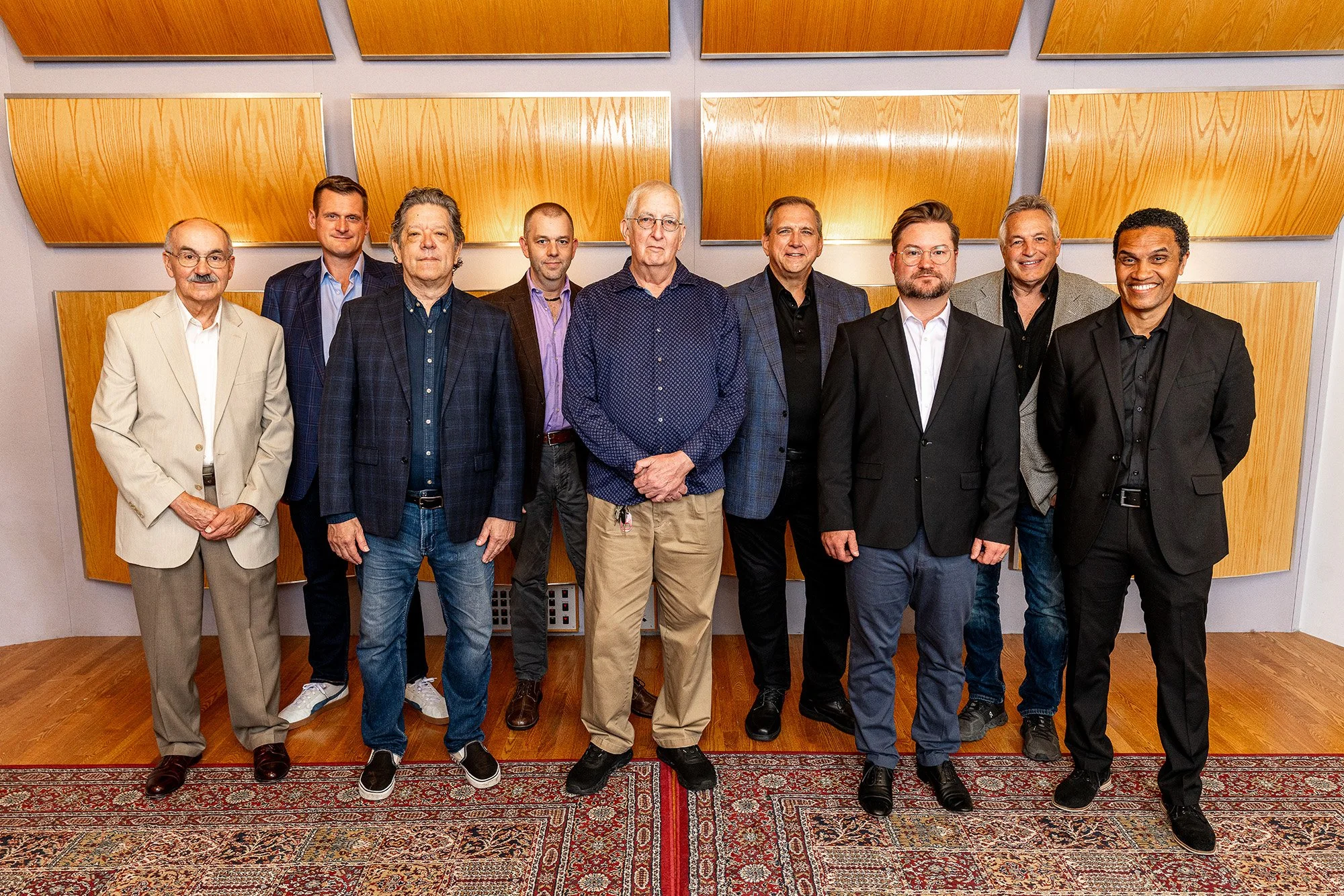
I photographed Mike Tomaro, J.D. Chaisson, Jeff Bush, Eric Susoeff, Max Leake, Paul Thompson, and Thomas Wendt together at Red Caiman Studios, along with recording engineer Jay Dudt and Dr. Beaudreau.
There is a nice bit of symmetry in that. The album was actually recorded at Audible Images Recording Studios in Pittsburgh during sessions spanning 2021 and 2025. By the time I photographed the group, Audible Images had become Red Caiman Studios, under new ownership.
So, while the name on the door had changed, the group photographs were made in the same physical location where the music had been recorded.
I had already spent time photographing Red Caiman itself, which I wrote about here. For that project, the rooms were the subject. This time, they became the setting for the musicians.
That connection gave the portraits a little more weight than I expected when we scheduled the session. The skyline establishes the city. The studio photographs establish the people. And, quietly, the room ties the visual side of the package back to the place where the record was actually made.
Seven musicians in the room
One detail from Dave’s notes stayed with me while I was working on the package.
These performances were recorded live in the studio. By intention, the group did not use after-the-fact digital corrections or overdubbing. What you hear is the musicians playing together. The liner notes also point to listening as one of the group’s defining strengths, with musical ideas appearing and reappearing from one soloist to another. That makes the group portrait feel particularly appropriate.
There are seven individual musicians standing in the photograph, each with his own career, voice, and history. But the record exists because of what happens between them.
The work around the music
I have written before about the work that surrounds a finished creative piece. This project is a particularly literal version of that idea.
Mike had the arrangements and the musicians. Dave had written the notes and, with JoAnn, helped make the project possible. Mike and Dave selected the cover photograph from the gallery I provided. Jay Dudt recorded and mastered the performances. My job was to take the photos, the writing, the credits, the track information, and the physical constraints of the package dimensions and turn them into one visual system.
For me, there was another layer running underneath all of that. Mike had been one of the people helping me learn how to make music when I was in college. Years later, I was helping build the object around music he had made. That is a pretty satisfying circle to close.
And as if all of that wasn’t enough, the project reaches beyond the musicians and everyone who worked on the album. All proceeds from online sales will benefit the Women’s Center & Shelter of Greater Pittsburgh. These guys are truly in it for the music, and I am humbled and proud that my design work gets to serve as the visual representation of what they created.
Not bad for a five-inch cardboard box.
——
As soon as the album drops, I’ll return here and link it so everyone who reads this can experience this incredible music.