Is It Social Strategy, or Does It Just Look Good Above the Couch?
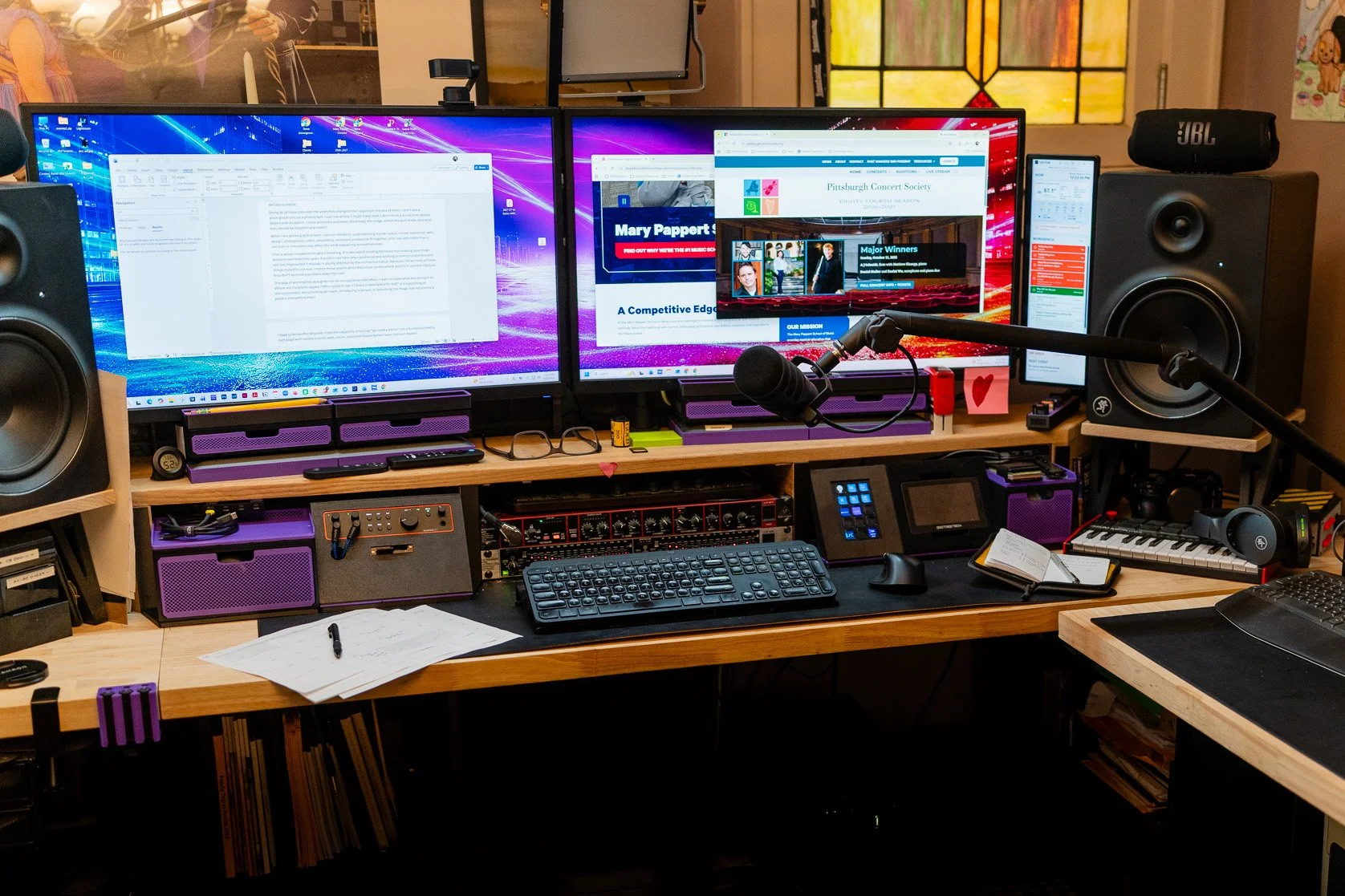
I was working on social media for Pittsburgh Concert Society this morning when I found myself thinking about everything that has to happen before a post can happen.
On paper, my role is fairly specific: social media. Social media, apparently, has not read the job description.
A post may need a photograph that does not yet exist. It may depend on information from someone else. It may need to coordinate with an email, lead to a page on the website, support an ad, or fit into a larger campaign that several people are helping to shape. That means that even an extremely simple post can be the visible end of a much longer chain of conversations, decisions, assets, and deadlines.
At PCS, those connections are especially easy to see because the work is shared. One person handles email. Another manages the website. The organization’s leadership is closely involved in developing projects, and the people featured in the content are part of the process as well. My piece may be social media, but it has to fit the pieces everyone else is building. That’s not a complication. It’s a clearer picture of what this work has always been.
In my role at Duquesne, I often handle many of those connected pieces within my own office. If a post needs photography, I take the photographs. If a campaign needs an ad or a graphic, I often design it myself. I communicate directly with the students, faculty, or staff involved. I build the email, update the web page, and make sure each part points to the others. And because so much of it happens within my own role, I do not always stop to think of each one of those things as separate jobs. I simply know what the project needs next, and I do it. Working within a more distributed team makes that same network of decisions visible.
Doing all of those jobs over the years has changed how I approach any one of them. I don’t see a photograph only as a photograph. I can see where it might travel next. I don’t think a social post always begins with a caption. I think about the audience, the timing, the image, where the post leads, and what else should be happening around it.
When I am working with a team, I am not limited to understanding my own piece. I know how email, web, design, photography, video, advertising, and event production fit together, and I can anticipate how a decision in one place may affect the work happening somewhere else.
That is where collaboration gets interesting. It is less about dividing the tasks than making sure those divisions don’t become gaps. A project can have very capable people working on every component and still feel fragmented if nobody is paying attention to the connective tissue. Because I do so many of these things myself in one role, I notice those seams when they show up elsewhere and try to address them so they don’t become a problem down the road.
This way of working has also given me an occupational side effect: I want to know what everything is for. Where will the photo appear? Who needs to see it? Does it need space for text? Is it supporting an announcement, documenting an event, introducing a person, or becoming the image that represents a project everywhere else?
I have to be careful because I have the capability of turning “we need a photo” into a formalized media campaign with outlets in print, web, social, and email blasts before I even notice it myself!
And honestly, those questions typically make the work better. A photograph intended for a website banner asks for something different than one destined for Instagram, a printed program, an advertisement, or a press release. Knowing where the work may go helps me make better choices while I am creating it.
It also makes me a better collaborator even when I am not responsible for producing those other pieces. I can give the next person what they are likely to need instead of handing them a beautiful problem.
But sometimes I have to stop myself, because sometimes there is no next person. There is no larger campaign waiting downstream. No landing page, coordinated email, or social rollout lurking around the corner with a clipboard.
Sometimes someone just wants a beautiful picture to hang on the wall. That is the intended use. That is the entire strategy. In those moments, the client is not asking me to help clarify a marketing objective. They are asking for my vision. They want to know what I notice, how I interpret it, and what I can make from it. If I keep searching for a larger purpose, I risk complicating the idea with a need the work never had.
That does not contradict the larger way I approach my work. It depends on it. Knowing the range of possible outcomes gives me better judgment about which ones matter, including when there does not need to be another outcome at all.
Versatility is not about making every project bigger. It is about being able to enter a project at one point and understand what is happening around it. Sometimes that means filling a gap, coordinating several moving parts, or anticipating the next step. Sometimes it means staying in my lane without developing tunnel vision. And sometimes it means recognizing that the lane ends at a very nice frame on someone’s wall.
The deliverable may be a post, a photograph, a web page, a video, or an ad. The work around the work determines how well it fits, how far it can travel, and how useful it will be to everyone who touches it next.
Or, occasionally, how good it looks above the couch.